So, I keep having to refer back to this, so instead of looking through old posts which mention it, I thought I'd make a post dedicated to Symbolic links.
So, to make a symbolic link it is simply:
ln -s /pathtoexistingfolder/ /pathtofolderyouwantsyboliclinkin/
Simple. Of course many occasions call for you to use the command line to check whether a folder is a symbolic link. To do this I use this command:
ls -l ~/Library/
If a folder in this list starts with an 'l' it means it is a symbolic link. I run this command to check whether the Caches folder is a symbolic link:
ls -l ~/Library/ | grep 'Caches'
What comes up if it is a symbolic link is:
lrwx------ 1 330986 wheel 19 Nov 21 11:37 Caches -> /tmp/330986/Caches/
Notice the "l" at the begining, and also the " -> " which then tells us where the symbolic link goes to.
Showing posts with label Work. Show all posts
Showing posts with label Work. Show all posts
Monday, 21 November 2011


Thursday, 21 July 2011
iPad setup and Deployment
So, I was shown this document on iPads in Business and it seems quite relevant to our situation. Looks like the setup is controlled by xml files which is nice, and there is potential for managing them wirelessly. The app we need is the "iPhone Configuration Utility" of which the latest version, 3.2, is only supported on OS X 10.6. Looking at back-dates I've found version 2.1 which apparently works on 10.5 and was the last to support it.
The information for iPhone Configuration Utility is found here. Nice simple interface which should make the job easier.
The information for iPhone Configuration Utility is found here. Nice simple interface which should make the job easier.
Wednesday, 20 July 2011
OS X Active Directory login issues - UnBind
I've seen this problem ever since we started putting Apple Macs on the Active Directory domain. Every now and then OS X will shake at login. I've rebooted and reset PRAM, fsck -yf, checked the time and date, and looked at the active directory settings in Directory Utility. The only real fix is to "Unbind" it and then "Bind" it again.
The only thing which comes to mind is perhaps the length of time it is not logged into is too long and the computer gets removed from Active Directory. Re-binding it puts it back in the list's.
The only thing which comes to mind is perhaps the length of time it is not logged into is too long and the computer gets removed from Active Directory. Re-binding it puts it back in the list's.
Monday, 18 July 2011
Imaging OS X 10.6.6 on OS X server 10.4.11
I have over 100 Macs which need reimaging this summer. To make it nice and simple they will all have 10.6.6 installed. Unfortunately I only have a 10.4.11 server (PPC) which I don't think will be upgraded before summer ends! At the moment I have 9 brand new 27" iMacs which don't like the current version of Deploy Studio RC20.
The reason I only have RC20 installed it that this was the last version to support OS X 10.4.11. Now, I also have 9 24" new'ish iMacs which do work with Deploy Studio RC20, and some relatively new Mac Pro's which definitely work with Deploy Studio RC20. So it is still worth perhaps using it for the 90 or so Macs and resort to other techniques to reimage the 9 which don't work. Of course over time I will need a new system but to have a really good new system we'll need time.
So the plan is to carry on using deploy studio for 90% of the Macs, and resort to something else for the last 10%. Alternatives are:
mkdir /Volumes/tmp
mount -t afp afp://username:password@server.somewhere.ac.uk/Images/ /Volumes/tmp/
It should be ready for restore now...
Restored 70GB compressed in 1 hour 45 over the old network, which isn't too bad. I don't think it'll be able to do multiple machines very efficiently though.
The next process is to try and create or use an old netboot image to netboot the slightly older machines. So it only gets easier from this moment onwards.
The reason I only have RC20 installed it that this was the last version to support OS X 10.4.11. Now, I also have 9 24" new'ish iMacs which do work with Deploy Studio RC20, and some relatively new Mac Pro's which definitely work with Deploy Studio RC20. So it is still worth perhaps using it for the 90 or so Macs and resort to other techniques to reimage the 9 which don't work. Of course over time I will need a new system but to have a really good new system we'll need time.
So the plan is to carry on using deploy studio for 90% of the Macs, and resort to something else for the last 10%. Alternatives are:
- Carbon Copy Cloner
- SuperDuper
- The install disk
- the install disk on a removable hard drive
- A bootable 10.6.6 on a removable hard drive
Well, I've looked up CCC and can't find any reference to it having some bootable interface. It simply copies a hard drive to another, which to be fair could be bootable, so I might do this.
I'm currently trying the easiest of these which is to use the install disk. I've managed to find the command line for mounting an AFP share. So I've open terminal from the booted up install disk and typed:
mkdir /Volumes/tmp
mount -t afp afp://username:password@server.somewhere.ac.uk/Images/ /Volumes/tmp/
The image that was taken from the 10.6.6 27" iMac was either done in DeployStudio helper or Disk Utility. When trying to restore this image to a drive in Disk Utility it has come up with an error message:
Restore Failure Could not find any scan information. The source image needs to be imagescanned/scanned for restoreI did a quick search and came up with this. I do now remember that to restore off a network share using disk utility it does need to be scanned for restore. Put the image in Disk Utility and go to: Image > Scan for Restore. This takes a long time on the old Apple Server G4, but not so long on the new 27" iMacs!
It should be ready for restore now...
Restored 70GB compressed in 1 hour 45 over the old network, which isn't too bad. I don't think it'll be able to do multiple machines very efficiently though.
The next process is to try and create or use an old netboot image to netboot the slightly older machines. So it only gets easier from this moment onwards.
Friday, 8 July 2011
Microsoft Office 2008 console errors
I've recently been trying to image a new iMac 27". So I've had to install a great many Applications and tested them out. I had a few problems with Adobe InDesign so on looking in the console log I found a lot of reference to Microsoft!

Anyway, I did a search and found this which basically says that Microsoft has not done a good job in porting office over to mac, and hence has a lot of misc console messages.

Microsoft Word[35252]: CGBitmapContextGetData: invalid context
Anyway, I did a search and found this which basically says that Microsoft has not done a good job in porting office over to mac, and hence has a lot of misc console messages.
Staff Photos - Use Access to change file names
I've got a nice little Access Database which holds a table of staff members, and another linking the staff to a photo file location. I then use a query to find members of a specific department with a photo and make a tiled report i.e. a staff board with names and job titles.
I've recently been asked to make the staff photos available for everyone, but the problem is they would not want to use the database in its present state (it doesn't look too pretty) and all the photos are still sorted in the folders corresponding to the photo-shoot date and still have their original file name. The question has come up - Can I get Access to rename the photos to say the staff name?
Well, I've done a bit of research (a google search) and it looks like to use access I'd have to do a bit of programming!! But there is this ingenious solution. Basically:
I've recently been asked to make the staff photos available for everyone, but the problem is they would not want to use the database in its present state (it doesn't look too pretty) and all the photos are still sorted in the folders corresponding to the photo-shoot date and still have their original file name. The question has come up - Can I get Access to rename the photos to say the staff name?
Well, I've done a bit of research (a google search) and it looks like to use access I'd have to do a bit of programming!! But there is this ingenious solution. Basically:
- Export a excel file of staff name and picture file location
- open excel and format it so that you get each row to say "ren \Photoshoot1\DSC00342.jpg \ArtAndDesign\StephenBleach.jpg"
- Then you can make a *.BAT file with a whole list of these commands and "bobs your uncle" you have renamed all the files and it'll only have taken about 30 mins.
You can even adapt it to put them in directories according to Department! Genius!
But, rather then doing all this, I'd rather the college had a better system (i.e. not me) of gathering and sorting staff photos using some centralised system which everyone can take advantage of.
Thursday, 7 July 2011
Setting up the new 27" iMacs
Setup started with the simple "hold down the n button" to netboot/netinstall. The first problem was that the current netinstall image would not work on the new iMacs, doh! So I set about making a new one. The old deploy studio RC20 seems to crash whilst making an image, so I needed to use a newer one. This newer one imaged without crashing, but when netbooting came up with a message saying the server needed updating to cope with the new netboot image.
The next thing I tried was to put an iMac in target disk mode and just reimage it using a 24" imac with I know works. I put the Mac Pro 10.6.6 image on it but would not boot up. This was probably due to new drivers not being on the image!
My last attempt is to start from scratch (or nearly from scratch) and install everything. I updated the operating system to the latest 10.6.8. I took a shortcut though and used "Migration Assistant" to pull across applications from the 10.6.6 image. This worked and only required me to install the newest of things. Heres a list of things which is now on the new iMac:
The next thing I tried was to put an iMac in target disk mode and just reimage it using a 24" imac with I know works. I put the Mac Pro 10.6.6 image on it but would not boot up. This was probably due to new drivers not being on the image!
My last attempt is to start from scratch (or nearly from scratch) and install everything. I updated the operating system to the latest 10.6.8. I took a shortcut though and used "Migration Assistant" to pull across applications from the 10.6.6 image. This worked and only required me to install the newest of things. Heres a list of things which is now on the new iMac:
- Adobe CS5
- Final Cut Studio
- Firefox 4
- Acrobat 9 Pro
- Papercut client
- Celtx
- Office 2008 (required rosetta)
- Handbrake
And drivers
- Scanwizard
- Dell 3110 driver
- Pixma Driver
- Konica Driver
- HP Scanner 4370
- Wacom tablet
- Flip4Mac
After all this I tried a students account. It required 2 login attempts to get me in though. I then tried all the apps. The problems I encountered were:
- Photoshop crash on launch
- Illustrator crash on launch
- Indesign crash on launch
- Acrobat crash on launch
These were probably due to NHR (network home relocation) script not installed. I installed it and Photoshop and Acrobat started working. Unfortunately Illustrator nor InDesign would work! They worked perfectly fine on a local login. I ran the CS5 install again, and also updated Illustrator to 15.0.2 and InDesign to 7.0.4. Illustrator would crash on load up, and indesign would crash on the "new document" screen which comes up first. My only clue was a message which popped up in console which I can't quite remember now. Something to do with transport2app error 255.
Just relogged in and tried it again. The error's I'm getting from the console are:
07/07/2011 14:01:43 kernel smbfs_vnop_link: warning: pid 665(Adobe Illustrato) hardlink(~v3vZO_cBdNvr4jqB)
07/07/2011 14:01:49 mdworker32[673] kCGErrorFailure: Set a breakpoint @ CGErrorBreakpoint() to catch errors as they are logged.
07/07/2011 14:01:51 mdworker[658] CFPropertyListCreateFromXMLData(): Old-style plist parser: missing semicolon in dictionary.
The first refers to the smbfs (samba file system) which must be the home drive of the student which is hosted on a windows share.
The only real difference is that the operating system in 10.6.8 instead of 10.6.6. I think I will have to redo this on a 10.6.6 machine....
So, redone a 10.6.6 version and migrated everything from 10.6.8 iMac. Everything worked! (apart from Adobe Acrobat and Dreamweaver. Acrobat crashes and dreamweaver gets stuck even loading up. I installed NHR and still the same. Interestingly Illustrator worked without NHR!
Looking into the issue a little more, I found that NHR is not entirely working. I've noticed that the caches folder is not being relocated, although the fonts folder is? I will have to look into this further. At the time I thought this was due to the test account having the links set up already from another machine, but thinking about it now these links should be deleted on logout! So now I'm thinking about it, it was originally working and now somehow it is not working any longer.
So, redone a 10.6.6 version and migrated everything from 10.6.8 iMac. Everything worked! (apart from Adobe Acrobat and Dreamweaver. Acrobat crashes and dreamweaver gets stuck even loading up. I installed NHR and still the same. Interestingly Illustrator worked without NHR!
Looking into the issue a little more, I found that NHR is not entirely working. I've noticed that the caches folder is not being relocated, although the fonts folder is? I will have to look into this further. At the time I thought this was due to the test account having the links set up already from another machine, but thinking about it now these links should be deleted on logout! So now I'm thinking about it, it was originally working and now somehow it is not working any longer.
Thursday, 19 May 2011
Adobe Actobat pro silent installer
After uninstalling Adobe CS4 and installing CS5, I noticed no Acrobat Pro. I do remember that it did have a seperate disk. So after speaking with computer services there is a silent installer on Marks test2 computer, in Applications/Adobe CS5/setup.exe. I'm not exactly sure if it installs the whole thing or just Acrobat Pro, but I did have trouble trying to run it.
Mark emailed me and suggested Mapping his distribution share as a drive letter. This worked.
Mark emailed me and suggested Mapping his distribution share as a drive letter. This worked.
Tuesday, 17 May 2011
nviro-cleansolutions search engine optimisation SEO
Monday, 16 May 2011
Mac OS X Default Paper Size plist file
For some reason in one room in particular when someone prints to the Dell Colour Laser 3110 the default paper size is Letter. I thought I'd set it up a long time ago not to be. So I've found this thread which mentions the file location for default paper size:
~/Library/Preferences/com.apple.print.PrintingPrefs.plist
It contains:
DefaultPaperID
iso-a4
Add this to a plist file to the "details" tab in a computer list group in workgroup manager and see what happens.
~/Library/Preferences/com.apple.print.PrintingPrefs.plist
It contains:
Add this to a plist file to the "details" tab in a computer list group in workgroup manager and see what happens.
Monday, 28 March 2011
Copying printers from one computer to another - windows
I've currently got a PC running windows server 2000 acting as a print server. It's essentially just sharing it's printers, but all computers in the department use the shared printers on this computer. It runs very well even though the computer is about 8 years old. We've also got PaperCut NG install with unlimited user license which gives each user £2 credit each week and deletes any jobs costing more then what the user has in credit. It's saved a lot of money down to wasted prints!
Just one problem we have now is that if this old computer fails, no one can print in the department. My plan is to copy the printers from this computer to another and if the server fails, simply rename the new computer to the old computers name and everything should go quite smoothly. The only thing which won't work is the print quotas, but this wouldn't take too long to fix.
So, after reading up on how other people do it (and also trying your simple copy and paste and other menu's on the computer) I found this where they talk about Print Migration Utility. Works like a dream. Load it up on the original computer, backup the printers to a cab file. Load the program on the new computer and restore it from the cab file. Takes a while as it installs all the correct printer drivers, but what amazed me was that it was from windows server 2000 to windows xp. Perfect.
Just one problem we have now is that if this old computer fails, no one can print in the department. My plan is to copy the printers from this computer to another and if the server fails, simply rename the new computer to the old computers name and everything should go quite smoothly. The only thing which won't work is the print quotas, but this wouldn't take too long to fix.
So, after reading up on how other people do it (and also trying your simple copy and paste and other menu's on the computer) I found this where they talk about Print Migration Utility. Works like a dream. Load it up on the original computer, backup the printers to a cab file. Load the program on the new computer and restore it from the cab file. Takes a while as it installs all the correct printer drivers, but what amazed me was that it was from windows server 2000 to windows xp. Perfect.
Wednesday, 2 March 2011
Squid proxy server setup for iTunes authentication through another proxy
Yay, nice new shinny iPads. What could possibly go wrong. Doh! iTunes doesn't like the proxy server.
# ----------------------------------------------------------------------
# WARNING - do not edit this template unless you know what you are doing
# ----------------------------------------------------------------------
# the parent cache
cache_peer xxx.xxx.1.3 parent 8080 7 no-query no-digest no-netdb-exchange default login=username:password
# disk and memory cache settings
acl everything src all
cache deny everything
maximum_object_size 4096 KB
# store coredumps in the first cache dir
coredump_dir /usr/local/squid/var/logs
# the hostname squid displays in error messages
visible_hostname localhost
# log & process ID file details
cache_access_log /usr/local/squid/var/logs/squid-access.log
cache_log /usr/local/squid/var/logs/squid-cache.log
cache_store_log /usr/local/squid/var/logs/squid-store
pid_filename /tmp/squid.pid
# Squid listening port
http_port 8080
# Access Control lists
acl localhost src 127.0.0.1/32
acl to_localhost dst 127.0.0.0/8 0.0.0.0/32
acl manager proto cache_object
acl SSL_ports port 443
acl Safe_ports port 80 # http
acl Safe_ports port 21 # ftp
acl Safe_ports port 443 # https
acl Safe_ports port 70 # gopher
acl Safe_ports port 210 # wais
acl Safe_ports port 1025-65535 # unregistered ports
acl Safe_ports port 280 # http-mgmt
acl Safe_ports port 488 # gss-http
acl Safe_ports port 591 # filemaker
acl Safe_ports port 777 # multiling http
acl CONNECT method CONNECT
acl allowed src 127.0.0.1
acl godirect dstdomain .somewhere.co.uk
# Only allow cachemgr access from localhost
http_access allow manager localhost
http_access deny manager
# Deny requests to certain unsafe ports
http_access deny !Safe_ports
# Deny CONNECT to other than secure SSL ports
http_access deny CONNECT !SSL_ports
# protect web apps running on the proxy host from external users
http_access deny to_localhost
# rules for client access go here
http_access allow localhost
http_access allow allowed
# after allowed hosts, deny all other access to this proxy
# don't list any other access settings below this point
http_access deny all
# specify which hosts have direct access (bypassing the parent proxy)
always_direct allow godirect
always_direct deny all
# hierarchy stop list (squid-recommended)
hierarchy_stoplist cgi-bin ?
# refresh patterns (squid-recommended)
refresh_pattern ^ftp: 1440 20% 10080
refresh_pattern ^gopher: 1440 0% 1440
refresh_pattern -i (/cgi-bin/|\?) 0 0% 0
refresh_pattern . 0 20% 4320
always_direct deny all
never_direct allow all
 In the end, I just used the default settings, under General I put HTTP port to 8080, Visible hostame to localhost.

After speaking with the Network administrator, he showed me a mac already in use with ipod touches. The set-up on this machine uses a deamon called "Squid", which acts as a local proxy server. So this authenitcates itself with the real proxy server, and all programs on the machine communicate with squid as a localhost, so everything works just fine. It starts at startup,but I think it should start at login.
Here's the config files, squid.conf:
# ----------------------------------------------------------------------
# WARNING - do not edit this template unless you know what you are doing
# ----------------------------------------------------------------------
# the parent cache
cache_peer xxx.xxx.1.3 parent 8080 7 no-query no-digest no-netdb-exchange default login=username:password
# disk and memory cache settings
acl everything src all
cache deny everything
maximum_object_size 4096 KB
# store coredumps in the first cache dir
coredump_dir /usr/local/squid/var/logs
# the hostname squid displays in error messages
visible_hostname localhost
# log & process ID file details
cache_access_log /usr/local/squid/var/logs/squid-access.log
cache_log /usr/local/squid/var/logs/squid-cache.log
cache_store_log /usr/local/squid/var/logs/squid-store
pid_filename /tmp/squid.pid
# Squid listening port
http_port 8080
# Access Control lists
acl localhost src 127.0.0.1/32
acl to_localhost dst 127.0.0.0/8 0.0.0.0/32
acl manager proto cache_object
acl SSL_ports port 443
acl Safe_ports port 80 # http
acl Safe_ports port 21 # ftp
acl Safe_ports port 443 # https
acl Safe_ports port 70 # gopher
acl Safe_ports port 210 # wais
acl Safe_ports port 1025-65535 # unregistered ports
acl Safe_ports port 280 # http-mgmt
acl Safe_ports port 488 # gss-http
acl Safe_ports port 591 # filemaker
acl Safe_ports port 777 # multiling http
acl CONNECT method CONNECT
acl allowed src 127.0.0.1
acl godirect dstdomain .somewhere.co.uk
# Only allow cachemgr access from localhost
http_access allow manager localhost
http_access deny manager
# Deny requests to certain unsafe ports
http_access deny !Safe_ports
# Deny CONNECT to other than secure SSL ports
http_access deny CONNECT !SSL_ports
# protect web apps running on the proxy host from external users
http_access deny to_localhost
# rules for client access go here
http_access allow localhost
http_access allow allowed
# after allowed hosts, deny all other access to this proxy
# don't list any other access settings below this point
http_access deny all
# specify which hosts have direct access (bypassing the parent proxy)
always_direct allow godirect
always_direct deny all
# hierarchy stop list (squid-recommended)
hierarchy_stoplist cgi-bin ?
# refresh patterns (squid-recommended)
refresh_pattern ^ftp: 1440 20% 10080
refresh_pattern ^gopher: 1440 0% 1440
refresh_pattern -i (/cgi-bin/|\?) 0 0% 0
refresh_pattern . 0 20% 4320
always_direct deny all
never_direct allow all
To get this running there is some things to run, there might be a GUI. But thinking about it, the machine was running 10.6, and I'm running 10.5, doh! I'll have to check out if it works on this first.
So, it doesn't come with 10.5. Downloaded latest version and found this website. Didn't work. You need a compiler which doesn't come on the mac, doh! Tried installing GCC compiler, which doesn't work either! Doh!
So I searched for a GUI for Squid and found SquidMan. Works very nicely, with no messing about with compiling, yay. Had a little trouble getting it to work. What is also good is that you can manipulate the config file it uses! So I copied and pasted from above, but errors came up about permission to write to log files. I left the log files section alone and pasted the rest but it came up with permission denied.
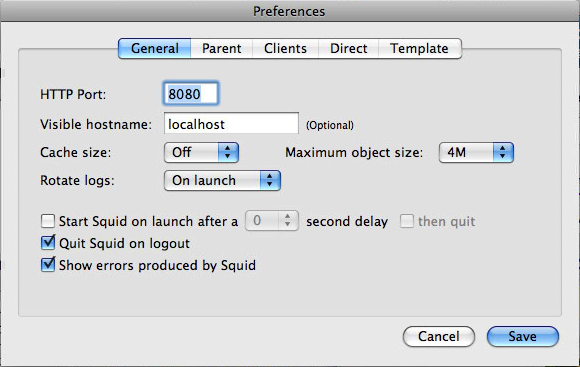 In the end, I just used the default settings, under General I put HTTP port to 8080, Visible hostame to localhost.
Under parent I put "Use a parent proxy server", hostname proxy.chesterfield.ac.uk port 8080, and ticked "Parent requires authentication. But putting username and password here doesn't seem to work. Leaving them blank asks you for a username and password when the service starts and works without putting domains in. Yay!
Friday, 18 February 2011
OS X change printer settings
So a printer IP address changed, and I print directly to it, so how do you change the IP address of a printer already in your printer list in OS X 10.5?
Well, I found this post which basically says you can change the /etc/cups/printers.conf file. This isn't too easy as first you need to change file permissions. I opened in textedit and changed the IP address only to find this did not change the settings, presumably some service needs rebooting. Looks like it works off the "printers.conf.0" file. So I eventually gave up and just re-added the printer!
Well, I found this post which basically says you can change the /etc/cups/printers.conf file. This isn't too easy as first you need to change file permissions. I opened in textedit and changed the IP address only to find this did not change the settings, presumably some service needs rebooting. Looks like it works off the "printers.conf.0" file. So I eventually gave up and just re-added the printer!
Thursday, 10 February 2011
iMac 21.5" - 11, 2 - 10.6.6 - Installation and deployment - Part 2
After NetInstalling OS X 10.5.8 on the new iMac I got a black screen. I still think it was worth a try.
So, I swapped the "fully updated" one for another new iMac so I could start at OS X 10.6.4. Tried Active Directory and it worked fine, as well as NHR login scripts. So I jumped to the conclusion that it was in the use of "Migration Assistant" that some 'damage' occurred. But, I was still cautious of updating the operating system any further. My plan is/was to update everything else, image it, then update the operating system to see if everything still works and carry on accordingly.
So, I had to start from scratch and installed:
Scanners:
Printers:
Tablets:
So, I swapped the "fully updated" one for another new iMac so I could start at OS X 10.6.4. Tried Active Directory and it worked fine, as well as NHR login scripts. So I jumped to the conclusion that it was in the use of "Migration Assistant" that some 'damage' occurred. But, I was still cautious of updating the operating system any further. My plan is/was to update everything else, image it, then update the operating system to see if everything still works and carry on accordingly.
So, I had to start from scratch and installed:
- Final Cut Studio 2 - had to install at least 3 times to get 'all' the files
- Aperture
- Adobe CS5
- Adobe Acrobat Pro 9 - no serial number
- CeltX
- Audacity
- iWork 09
- Burn
- ClickView
- DivX
- Firefox 3.6.13
- Handbrake
- Office 2008
- Mplayer Ex...
- DeployStudio RC20
- NHRBasic
- Flip4Mac
- ARD Client 3.4
- PCclient
- Don't have "Logic" Disks on server
- VLC 1.1.7
Scanners:
- HP Scanjet 4370
- Nikon CoolScan 8000
- Scanwizard Pro 7.20
Printers:
- 5550
- 3110
- Canon Pixma IP4500
- Konica 7300
Tablets:
- PenTablet 521-3 - I think this covers all the tablets we have.
Forgot also to add "Media" user to the local users.
I partitioned the HD via Boot Camp Assistant and formatted it as HFS+ Journaled, named "Scratch Disk". Just going to make the first image now.....
.... and now just updated to 10.6.6, and student login worked just fine! So to conclude, "Migration Assistant" probably isn't good for transferring apps across operating system versions.
I am now imaging using Deploy Studio, but having to clear a bit of space on the server so it can fit on. The space taken on the iMac is 85GB, it needed more then 130GB (not sure how much more) for doing server side compression, I've now freed up 200GB on the server. 78 mins till it's uploaded, but then it'll take the old server, bless the poor thing, quite a while to compress the image.
... I left it over night and it did it. A nice thing to note is that if you use a local repository, I think it doesn't use the server to compress the image.
Worked a charm, and even worked with multicasting, yay.
.... and now just updated to 10.6.6, and student login worked just fine! So to conclude, "Migration Assistant" probably isn't good for transferring apps across operating system versions.
I am now imaging using Deploy Studio, but having to clear a bit of space on the server so it can fit on. The space taken on the iMac is 85GB, it needed more then 130GB (not sure how much more) for doing server side compression, I've now freed up 200GB on the server. 78 mins till it's uploaded, but then it'll take the old server, bless the poor thing, quite a while to compress the image.
... I left it over night and it did it. A nice thing to note is that if you use a local repository, I think it doesn't use the server to compress the image.
Worked a charm, and even worked with multicasting, yay.
Tuesday, 8 February 2011
iMac 21.5" - 11, 2 - 10.6.6 - Installation and deployment
Just received 10 new 21.5" iMacs, version "11, 2" , with 10.6.6 installed. Very nice, with quad core and 1GB Hard Drives, but having a few different issues has caused me to put them back to 10.5.8 temporarily until the main issues are fixed.
To streamline the operation I decided rather then starting from scratch, I would use Migration Assistant to transfer accounts and applications from the latest MacBook Pro which had everything on. This worked very well, but in heinsight might have caused the issues below. These problems need testing on a fresh install of OS X 10.6.6.
Issues which I encountered:
To streamline the operation I decided rather then starting from scratch, I would use Migration Assistant to transfer accounts and applications from the latest MacBook Pro which had everything on. This worked very well, but in heinsight might have caused the issues below. These problems need testing on a fresh install of OS X 10.6.6.
Issues which I encountered:
- Students on Active Directory require to put details in more then once before they can login, for machines only just switched on!! I think this is to do with how quick the mac boots up, too quick to authenticate itself on active directory?
- NHR (Network Home Redirector) scripts not running at login or logout.
- Deploy Studio netboot not working; firstly freezing on the white screen with the grey apple (no spinning wheel, and secondly crashing and rebooting when loading the next screen after the one just mentioned.
With the students active directory issue (not properly tested on staff accounts), there was not much to try as I think it is more of a problem with Active Directory Servers or how OS X 10.6.6 communicates with them, which is too time consuming at present (there is pressure to deploy iMacs within the next 2 days at most). I did some simply exploratory fixes:
- take off of active directory and put it back on
- make sure everything was up-to-date
- refer back to solution 1.
When there is more time I shall need to look into this, but also future releases of the operating system will fix these. One thing I would like to do is try active directory logins on a fresh install of the operating system
With NHR I downloaded the latest, 3.2.6, uninstalled and reinstalled. What might have caused the problems is that I transferred files from a MacBook Pro running 10.5.8, which might have transferred some of NHR Scripts but not all. I also tried the full version which creates more alias's. Unfortunately not much info on NHR website, no-one else seems to be having problems. One thing I would like to do is try the scripts on a fresh copy of 10.6.6.
After these two problems and diminishing time I decided it was best to revert to 10.5.8 until time would allow these problems to be resolved. But, I did not want my efforts to go to waste, so I decided to make a disk image of the machine with its' problems so I can continue later. Little was I to suspect any more issues. I held down 'N' for netboot to DeployStudio and the machine froze on the white screen with the grey apple (no spinning wheel). Doh! The problem was probably because the last deploy studio netboot image was made on a MacBook Pro 15" now 2 years old.
I subsequently made a new netboot image (nbi) from this iMac and tried again, this time to get the spinning wheel but to crash on trying to load the next screen! This was probably due to outdated DeployStudio (currently using RC14 on the server and RC 15 on clients). I updated the client to the latest and the same happened again! So I updated the server, but alas, the installer said the minimum requirements were not met!! Server is running 10.4.11!!! Needs updating!!! So I go traipsing around for the last version to support 10.4.11 server, which was a lot of hassle. I'd like to not that the DeployStudio website (both Wiki and main site) are not good for troubleshooting, with only the latest versions available. I finally found RC20 here. Eventually worked! Yay.
After this I went to make an image of the drive but alas, not enough room on the server. So I used Boot Camp Assistant in OS X 10.6.6, and partitioned the drive - 160GB for OS X and the rest for "Scratch Disk". I then NetBooted again and used Disk Utility to make a compressed Disk Image and put it on the Scratch. Turned out to be 79GB, original was 106GB.
So now to put OS X 10.5.8 on, which will hopefully work on this machine!!
After these two problems and diminishing time I decided it was best to revert to 10.5.8 until time would allow these problems to be resolved. But, I did not want my efforts to go to waste, so I decided to make a disk image of the machine with its' problems so I can continue later. Little was I to suspect any more issues. I held down 'N' for netboot to DeployStudio and the machine froze on the white screen with the grey apple (no spinning wheel). Doh! The problem was probably because the last deploy studio netboot image was made on a MacBook Pro 15" now 2 years old.
I subsequently made a new netboot image (nbi) from this iMac and tried again, this time to get the spinning wheel but to crash on trying to load the next screen! This was probably due to outdated DeployStudio (currently using RC14 on the server and RC 15 on clients). I updated the client to the latest and the same happened again! So I updated the server, but alas, the installer said the minimum requirements were not met!! Server is running 10.4.11!!! Needs updating!!! So I go traipsing around for the last version to support 10.4.11 server, which was a lot of hassle. I'd like to not that the DeployStudio website (both Wiki and main site) are not good for troubleshooting, with only the latest versions available. I finally found RC20 here. Eventually worked! Yay.
After this I went to make an image of the drive but alas, not enough room on the server. So I used Boot Camp Assistant in OS X 10.6.6, and partitioned the drive - 160GB for OS X and the rest for "Scratch Disk". I then NetBooted again and used Disk Utility to make a compressed Disk Image and put it on the Scratch. Turned out to be 79GB, original was 106GB.
So now to put OS X 10.5.8 on, which will hopefully work on this machine!!
Wednesday, 19 January 2011
Adobe Acrobat OS X Active Directory Crash
So after fixing Adobe Acrobat admin password problem acrobat 8 loads up, but crashes after 20 seconds. I remember fixing this exact problem with Marketings' computer, Louise Webster I think.
Doh! I didn't write the solution in the blog!!! Lesson learned over and over again. So here's the brief explination I told Paul Jenkins by email:
Doh! I didn't write the solution in the blog!!! Lesson learned over and over again. So here's the brief explination I told Paul Jenkins by email:
Hi Paul,
I went over at 12 today to have a look. It appears to have problems on any active directory accounts which aren’t administrators. Its a permissions issue because acrobat (and lots of other programs) write temp files to the users home drive with the wrong permissions. The NHR program was installed but only redirects caches and fonts folders to the local drive, but still didn’t fix the acrobat problems. I found another folder which needed re-directing - “~/Library/Application Support/Adobe/Acrobat/”
I made a folder in “/Users/Shared/Websterl/” and created an alias in her “/Library/Application Support/Adobe/Acrobat/” so it gets re-directed to the local drive. It only works on this machine for only her at the moment. If any more people have the same problem it would be worth adding an entry in the NHR program for acrobat.
I also noticed the programs and operating system weren’t up-to-date. I’ve set it updating adobe products. Louise said she’d get back in contact if she had any more problems. I didn’t get around to updating the operating system though.
Cheers
StephenI had a look at this folder and came up straight away with error! I remember not it was a folder within this folder: /Library/Application\ Support/Adobe/Acrobat/9.0_x86. So after redirecting this one it works. So to fix this problem for everyone, NHR program will need to do this as well! I'll find out how to do that tomorrow!
Unfortunately, NHR the full program redirects too many folders, i.e. Microsoft User Data, so I'll have to adapt the loginhook, logouthook, clean script files etc. But then I can copy them to all machines and it should be fine.
Thursday, 13 January 2011
OS X Active Directory login issues - delete parallels
I keep coming across Apple Macs which have been working in Active Directory and yet not letting users log in (or even use kerberos in Firefox). The general symptoms are:
- "Some network accounts available" at login screen (i.e. active directory not working, open directory working)
- not letting active directory users log in
- showing active directory working in "Directory Utility"
- letting you re-bind to active directory with no problems
- trying to use firefox with kerberos authentication comes up with "unable to ......." (can't remember the exact error)
I tried the simple fixes such as reset the PR Ram and fsck -yf. I was going to do a disk permissions fix but thought it'd take too long. I looked in the console and found a few kerberos errors.
I found that there were a few errors with the network settings. I found that because the image was taken from a computer with Airport, it hadn't updated this and thought the ethernet connection was in fact an airport connection. I deleted the "Chesterfield College" location and made it "automatic" but deleted the airport which fixed that. I also noticed two Parallels shared connection network interfaces, which were set up when I was trialing Parallels. On deleting these and logging out, active directory accounts worked. But on reboot the devices were remade. So there was some files somewhere which remade the connections. I thought it be quicker looking for help rather then looking for files, and on a quick search I found some helpful stuff. Before I come to that I did notice that Parallels was actually still installed. So I recommend first you delete Parallels from the Applications folder.
Next would be deleting parallels library files. I found this forum, and down the bottom they mention:
cd /Library/
sudo rm -rf Parallels
cd /Library/Preferences/
sudo rm -rf Parallels
cd /Library/StartupItems/
sudo rm -rf ParallelsTransporter
cd /System/Library/Extensions/
sudo rm -rf prl_hid_hook.kext
sudo rm -rf prl_hypervisor.kext
sudo rm -rf prl_vnic.kext
sudo rm -rf prl_usb_connect.kext
sudo rm -rf prl_netbridge.kext
cd /Users//
sudo rm -rf .parallels/
sudo rm -rf .parallels_settings
sudo rm -rf Parallels
cd /Library/Preferences/
sudo rm -rf Parallels
cd /Library/StartupItems/
sudo rm -rf ParallelsTransporter
cd /System/Library/Extensions/
sudo rm -rf prl_hid_hook.kext
sudo rm -rf prl_hypervisor.kext
sudo rm -rf prl_vnic.kext
sudo rm -rf prl_usb_connect.kext
sudo rm -rf prl_netbridge.kext
cd /Users/
sudo rm -rf .parallels/
sudo rm -rf .parallels_settings
I of course did all of this, but I think just deleting the Parallels application should do the job.
.... well, had a little play around and it turns out it's best doing all of it and heres ARD send command thing (under root)
rm -R /Applications/Parallels
rm -R /Applications/Parallels\ Desktop.app
rm -rf /Library/Parallels
rm -rf /Library/Preferences/Parallels
rm -rf /Library/StartupItems/ParallelsTransporter
rm -rf /System/Library/Extensions/prl_hid_hook.kext
rm -rf /System/Library/Extensions/prl_hypervisor.kext
rm -rf /System/Library/Extensions/prl_vnic.kext
rm -rf /System/Library/Extensions/prl_usb_connect.kext
rm -rf /System/Library/Extensions/prl_netbridge.kext
rm -rf /Users//.parallels/
rm -rf /Users//.parallels_settings
It's impossible to delete network devices via command line, but doing the above disconnects them, which is the next best thing.
.... well, had a little play around and it turns out it's best doing all of it and heres ARD send command thing (under root)
rm -R /Applications/Parallels
rm -R /Applications/Parallels\ Desktop.app
rm -rf /Library/Parallels
rm -rf /Library/Preferences/Parallels
rm -rf /Library/StartupItems/ParallelsTransporter
rm -rf /System/Library/Extensions/prl_hid_hook.kext
rm -rf /System/Library/Extensions/prl_hypervisor.kext
rm -rf /System/Library/Extensions/prl_vnic.kext
rm -rf /System/Library/Extensions/prl_usb_connect.kext
rm -rf /System/Library/Extensions/prl_netbridge.kext
rm -rf /Users//.parallels/
rm -rf /Users//.parallels_settings
It's impossible to delete network devices via command line, but doing the above disconnects them, which is the next best thing.
Mac OS X Power Saving Schedule via Command Line
I now have, or want to have, all computers booting up on weekdays at 8:30 which will give me a good idea of which ones are working and which aren't via Remote Desktop. Also I have them shutting down at 16:50 as they will not be needed after this time (apart from times when they might be doing updates/scripts but I'll just have to remember this problem)
I also plan on changing the schedule for Half Terms and holidays so no extra power is wasted.
To control it all the xserve is set up to manage machine preferences and so through Workgroup Manager I change the preferences. A problem I'm having is that not all machines boot up at 8:30 even though they all appear in good working order. To check/manage preferences from Remote Desktop (to troubleshoot also) you can use the command line:
pmset -g sched
This works well and gives you what the schedules are. So far they are telling the right schedules:
N251-04899 (192.168.32.22)
Repeating power events:
wakepoweron at 8:30AM weekdays only
shutdown at 4:50PM every day
Scheduled power events:
[0] wakeorpoweron at 01/14/11 08:30:00 by Repeating
[1] shutdown at 01/13/11 16:50:00 by Repeating
I'll update this more when I find out more.
Tuesday, 11 January 2011
Final cut pro "Preview Disabled"
So yesturday a student was capturing film from a DV deck. Logged out for break and logged back in and low and behold when in "Log and Capture" it said "Preview Disabled". So I tried different tapes, different computer, different user (cove), different PAL settings and refresh rates to no avail. Only thing I didn't try was different tape deck (all were in use).
A quick search on google came up with a few results:
A quick search on google came up with a few results:
- Switch from PAL to other and then switch back (should refresh it)
- View drop-down menu in FCP and clicking on 'Refresh AV devices'
- Trying leaving the camera on and plugged into your Mac and then reboot your computer
after this guess I'll do some more searching (maybe even in console)
Wednesday, 15 December 2010
ARD Client not working
I've had a problem with about 20 apple macs refusing to work with Apple Remote Desktop. They would screen share but I could not get ARD admin to connect to ARD client on these machines. I tried many things including:
Only on re-imaging the machine would the computer comumicate with ARD admin.
I had the chance yesturday to sit down at one of these computers and work out what was wrong. Restarting the services was the first port of call. I then moved on to the "Console". This showed an ARD error message about "/Library/Application\ Support/Apple/Remote\ Desktop/Client/Tasks/..../OS X 10.5.8/.....plist not a directory. I thought this would be related to the Task Server as I did send this update to all computers. I stopped the task server but the error kept coming up. When I stopped ArD client the error stopped. I decided to rename the directory (which was owned by root) using the below command:
Yay! It worked. Probably a permissions problem with that folder which was created during the update. I noticed that the ARD icon at the top turned from gray to black. On ARD admin I had to re-type the password for the particular mac (but I could have restarted ARD which would have refreshed it). This fixed all other computers. Only bad thing was that I had to go around these computers personally because ARD wasn't working on them. Oh well, it did give me a chance to check all the computer suites.
- Reinstalling ARD Client 3.3.2
- PR reset
- Disk Permissions
- OS X 10.5.8 update
Only on re-imaging the machine would the computer comumicate with ARD admin.
I had the chance yesturday to sit down at one of these computers and work out what was wrong. Restarting the services was the first port of call. I then moved on to the "Console". This showed an ARD error message about "/Library/Application\ Support/Apple/Remote\ Desktop/Client/Tasks/..../OS X 10.5.8/.....plist not a directory. I thought this would be related to the Task Server as I did send this update to all computers. I stopped the task server but the error kept coming up. When I stopped ArD client the error stopped. I decided to rename the directory (which was owned by root) using the below command:
su rootpassword ..................mv /Library/Application\ Support/Apple/Remote\ Desktop/Client/Tasks /Library/Application\ Support/Apple/Remote\ Desktop/Client/old_Tasks
Yay! It worked. Probably a permissions problem with that folder which was created during the update. I noticed that the ARD icon at the top turned from gray to black. On ARD admin I had to re-type the password for the particular mac (but I could have restarted ARD which would have refreshed it). This fixed all other computers. Only bad thing was that I had to go around these computers personally because ARD wasn't working on them. Oh well, it did give me a chance to check all the computer suites.
Subscribe to:
Posts (Atom)